
As tools like OpenClaw, Claude Code, and Codex become part of daily development, many people ask the same question: will programmers be replaced?
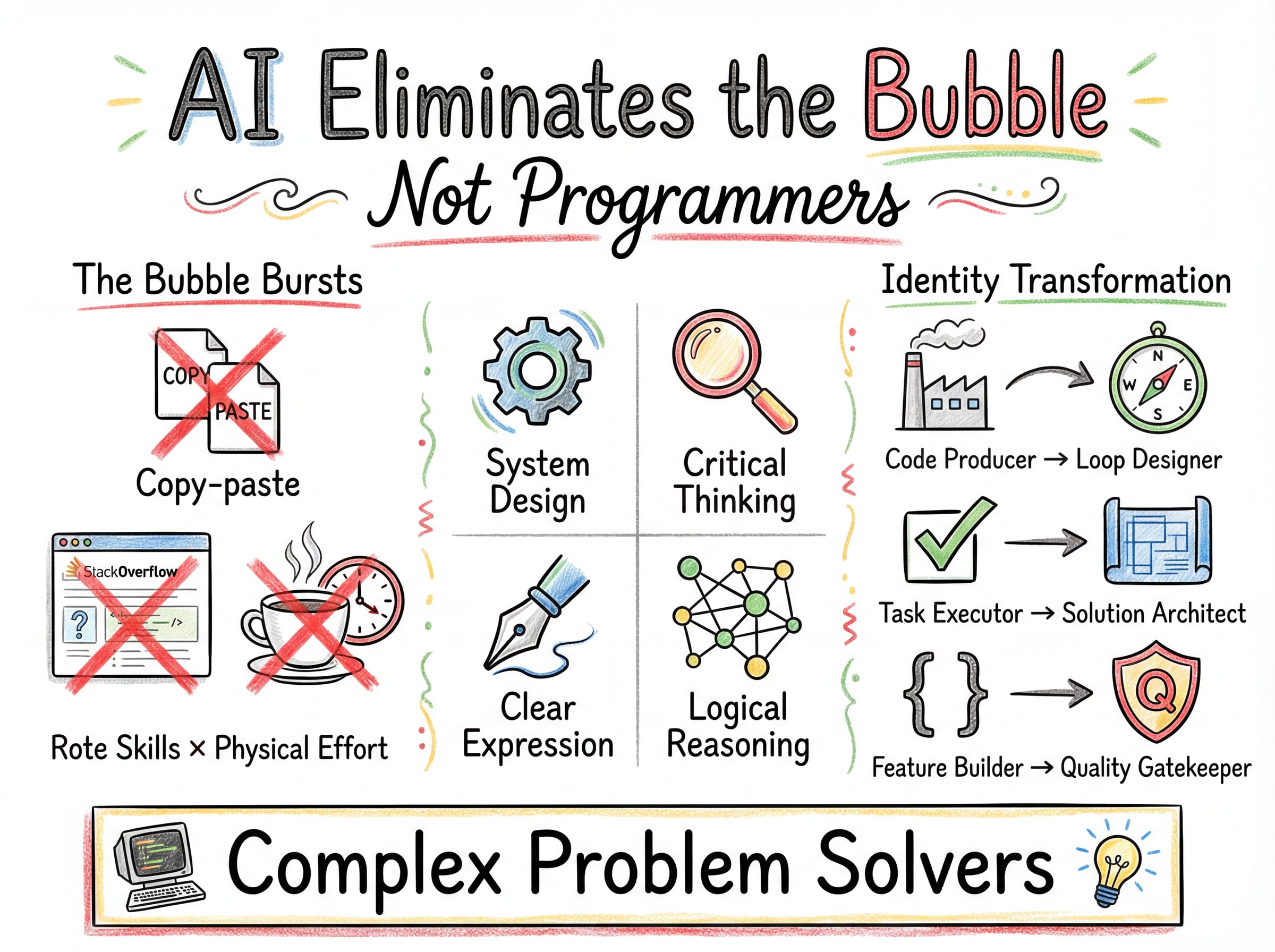
I think a more accurate conclusion is this: AI is not compressing the value of programmers as a profession. It is compressing the value of “pseudo-skills” that were overvalued during the industry bubble.
What Is Being Eliminated Is Not People, but Low-Leverage Work Patterns
In recent years, many “busy-looking” skills have been rapidly absorbed by AI:
- Assembling code from templates
- Solving problems by copy-pasting answers
- Relying on overtime and raw effort to push delivery
These are not the same as engineering capability. They were simply mispriced as “high output” in a specific market phase. Now AI can generate components, complete unit tests, and refactor boilerplate in seconds, so that value is naturally being repriced.
So the question is no longer “Will I be replaced?” It becomes “Is my value built on capabilities that are hard for AI to replace?”
The Four Most Valuable Capabilities in the AI Era
1) System Design Capability
AI can write code, but it cannot define system boundaries and constraints for you.
A valuable engineer has to answer these first:
- Why does this piece of code exist?
- What responsibility does it have in the system?
- How does it couple with upstream and downstream modules?
- Are future extension and testing costs under control?
The shift from “writing code” to “designing a closed loop” is fundamentally about defining rules, so AI can execute with consistent quality inside those rules.
2) Critical Thinking
The traditional path is “build first, debug later.”
A higher-level path is “anticipate risk first, then decide implementation.”
At the solution stage, you need to proactively identify:
- Whether hidden assumptions hold
- Whether boundary conditions are covered
- Whether exception paths are recoverable
- Whether performance and security risks are handled upfront
AI can generate runnable code, but it does not automatically own business consequences. The engineer’s value is turning “runnable” into “production-ready, evolvable, and accountable.”
3) Rigorous Written Communication
Many people treat prompting as “knowing how to write prompts.”
At the core, it is the ability to communicate clearly.
Whether in requirement clarification, design review, or cross-team collaboration, more precise communication means less rework.
Every constraint you write for AI and every requirement you write for teammates rely on the same core skill: remove ambiguity, add context, and define acceptance criteria.
4) Clear Logical Thinking
Logical thinking is the foundation of all engineering work:
- Breaking down complex problems
- Building causal chains
- Identifying key variables
- Making explainable technical trade-offs
As AI takes on more execution work, human value will continue to concentrate on “think clearly before acting.”
Three Role Shifts for Programmers
In the AI coding era, engineers are moving through three clear transitions:
-
From code producer to closed-loop designer
Core shift: from “how to write” to “what should be written and what should not.” -
From task executor to solution designer
Core shift: from “doing it manually” to “defining rules so AI can execute reliably.” -
From feature implementer to quality gatekeeper
Core shift: from “done is enough” to “defining what good actually means.”
This is not a downgrade. It is a return to the essence of engineering: programmers are not typists; they are problem solvers for complex systems.
A Practical Upgrade Path
If you want to complete one capability upgrade in three months, follow this sequence:
- For every requirement, write the problem definition and acceptance criteria before asking AI to code.
- Before each merge, run a “counterexample check”: failure paths, boundary conditions, and rollback strategy.
- Force short design notes for every major task: objective, constraints, approach, risks, and trade-offs.
- Treat AI output as first draft, and finish with human review for architecture consistency and quality gates.
If you keep doing this, you will feel the difference clearly: you are no longer competing with AI on typing speed. You are using AI to amplify engineering judgment.
Closing
AI has not made programmers unimportant.
It has only made pseudo-skills expire faster, while making real skills stand out faster.
When AI handles execution and humans define what “good systems, good code, and good delivery” mean, that may be the most natural next phase of engineering collaboration.