
Introduction: A Gentle Singularity
Over the past two years, I have felt like I was standing on a strange boundary: on one side is the familiar old world, driven by experience, manpower, processes, and projects; on the other is a new world accelerating forward, with AI seeping into every crack like groundwater.
Every quarter I analyze AI news, trends, and products, and I binge AI-related podcasts during my commute. That is just the environment I live in.
Yesterday I saw a video from Tim that opened with a chilling experiment: “draw a picture of a person drowning in the deep sea, struggling to breathe.” Nine human artists spent an hour on it, while six AI models took only 15 seconds. The harsher truth was that the AI images were high quality, highly varied in style, and could be regenerated endlessly.
That contrast sharpened a question that has been bothering me for a long time: is AI a wave, or a lighthouse? When AI can replace an hour of my effort in 15 seconds, what is the meaning of my existence? Is it a tool that changes the outside world, or a program that rewrites me?
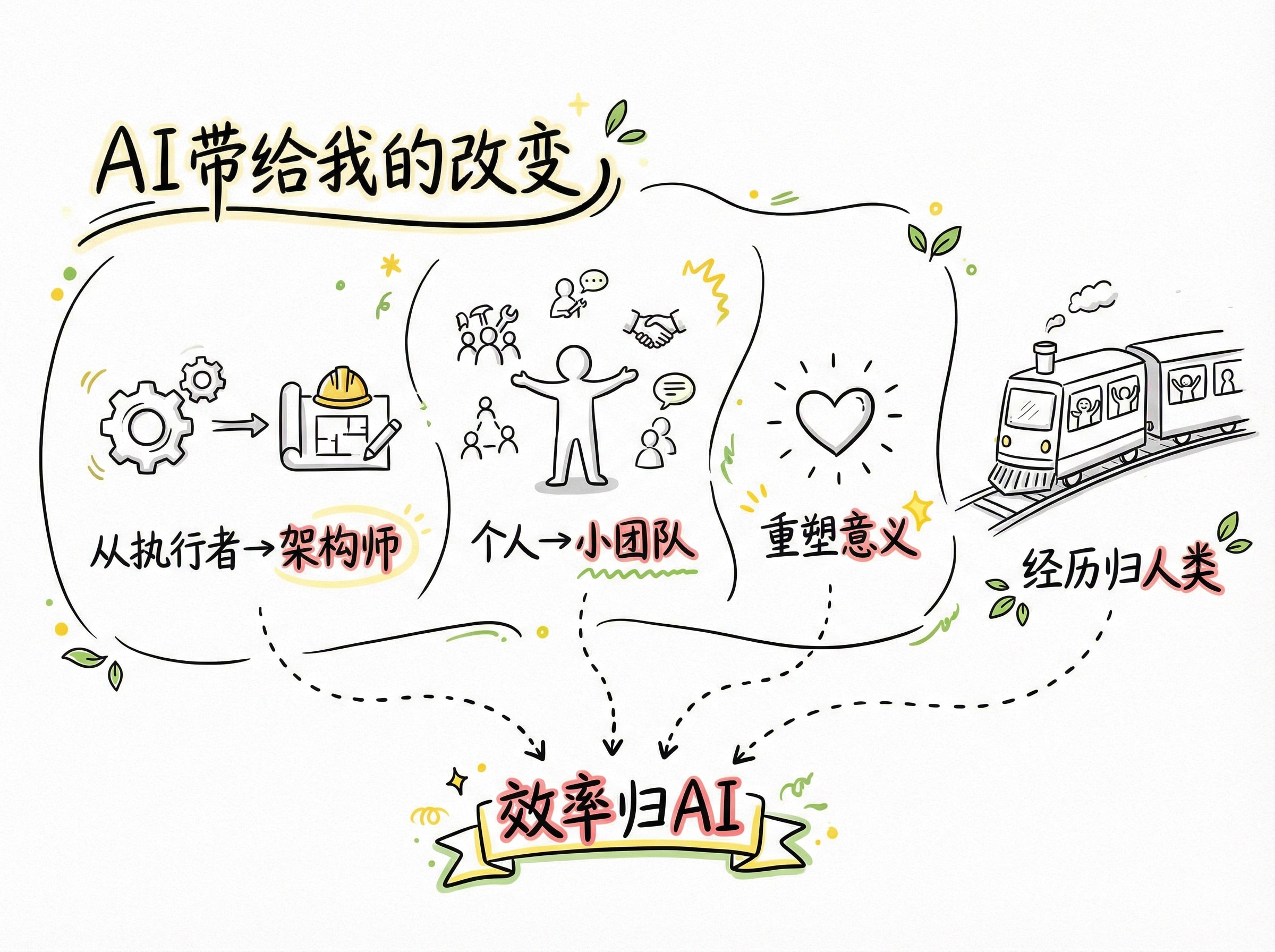
Looking back, the changes AI brought me can be split into three layers: a structural rewrite of how I work, an exponential amplification of my capabilities, and a quiet shift in my life trajectory.
AI Turned Me from a “Task Doer” into a “System Architect”
In the past, writing an architecture document was a war of willpower. Words, diagrams, structure, details, every part had to be built from scratch.
Now the process feels like collaborative engineering: I propose the core framework and AI expands the structure; I add business context and AI fills in the logic chain; I identify risks and AI offers alternative paths.
A document that used to take at least three days can now take just one night. The quality is often higher because I can spend more energy polishing concepts rather than grinding through sentences.
Tim’s video offers an even harsher footnote: his team once spent an entire year making a special-effects shot for “Galaxy Train.” In a traditional workflow, that would take five professional VFX artists for more than half a year (around 500 hours). But in 2025, the AI model Veo3 generated the same train-through-the-galaxy scene in two minutes, even with sound effects.
This is the “paradox of effort”: the more time and labor we pour into pure execution, the less meaningful the outcome may be, because AI evolves faster than we can refine our craft. The software skills and tricks we used to study late into the night can be devalued instantly.
In short: AI lifted me from “executor” to “structural engineer.” I am no longer just finishing tasks; I am designing systems.
AI Expanded My “Personal Ability” into a Small Team
If human ability is like a motherboard, AI is a plug-in expansion card you can attach at any time.
When I write code, it becomes a pair programmer. When I write system plans, it becomes an architect. When I create content, it becomes an editor, a scriptwriter, a media library, and an idea engine. When I need to talk to a financial advisor, it instantly switches into a financial analyst.
That ability to “switch professions on demand” first shocked me, then made me dependent, and now feels calm and normal, as if I have a 24/7 “shadow team” always on standby.
More importantly, it made me redefine a single word: boundary.
Before, I would think, “I am not good at this, I probably cannot do it.” Now it becomes, “Let me try. With AI as a safety net, it will not be too bad.”
So I started trying things I used to avoid: rebuilding my blog, creating content, understanding macroeconomics, preparing learning paths for my child. I began to connect across multiple domains and no longer feared crossing boundaries.
This is not inflation. It is a world quietly opened.
AI Helped Me Reshape the “Meaning of Work”
This might be the deepest change.
For a long time, work felt alienating: trivial, fragmented, passive, like a gear inside a machine.
But once I started using AI, I realized I was turning myself from a gear into a system designer. That shift itself is meaning.
When I design a two-year system evolution plan for my company, I am using AI to pull what I wanted to do but could not, back into my capability range.
When I design a learning path for my child, I am using AI to turn a father’s anxiety into deliberate action.
When I keep writing, I am using AI to turn accumulated experience into reusable knowledge assets, instead of scattered, temporary skills.
In other words, AI let me see that many things in work and life were not “I am not capable” but “I lack the right tools.” Once the tools arrived, my participation in the world was reactivated.
But that reactivation is not only about efficiency, it is about connection. Tim’s video told the story of the band “Deep Sea Breathing” and its singer, 57, which gave me a deeper understanding of “the meaning of work.”
57 had a serious illness, lost hearing, and faced a surgery with only a 60-70% success rate. He said something that broke my heart: “I am not afraid of life ending early. I am afraid that one day I will not be able to hear anything.” To help him fulfill his dream, the team rushed to finish the “Galaxy Train” MV before he went into surgery.
The surgery did not go perfectly. There was no miracle. He lost 30 kilograms, and his hearing did not improve much. But on the day the MV was released, 57 successfully proposed to his partner. In that moment, the efficiency of production and the precision of special effects (things AI can easily surpass) did not matter. What mattered was the bond between people that the project carried.
The meaning of work is not only about designing systems or boosting efficiency. It is about whether, through those systems, we can transmit love and courage. AI can generate perfect images, but it cannot understand the nervous sweat of a proposal, nor recreate the smell of dreams in a 60-yuan rehearsal room.
So What Do We Still Have?
If AI can do everything, faster, stronger, smarter than us, what do we have left?
Tim’s video gave a soul-piercing answer: “Maybe only experience. Experience shapes each of our unique souls.”
When you see your mother’s gray hair, your thoughts do not stop there. When you step onto your old campus and smell the classrooms, your memory is instantly awakened. These moments of feeling and these unique life experiences cannot be calculated or simulated by AI. AI cannot see through you, because it has not lived your life.
The final metaphor in the video about a “train” is deeply moving: in AI’s logic, trains are slow, heavy, inefficient, nowhere near fiber optics or rockets. It may not understand why humans feel attached to such an outdated vehicle. But trains have something special: “Even if boarding means separation, as long as the tracks remain and we still remember each other, one day we will meet again.”
Every time I finish overtime and drive home, I choose Gulou Avenue, even though the Second Ring Road is faster late at night. Besides speed, there are other things that matter.
This helped me see the other side of the AI revolution: AI can be the rocket that roars past, taking us higher to explore the boundaries of cognition. But we are still the person sitting by the train window (or driving), holding the hand of someone beside us and feeling our heartbeat.
Efficiency belongs to AI. Experience belongs to humans.
The Value of AI Is Never Replacement, but Upgrade
It brings efficiency, but also direction. It changes work, but also changes mindset. It accelerates professional growth, but also reshapes self-understanding.
I do not know what the future holds, but at least right now I can feel one thing clearly: AI is not just a tech trend, it is a personal revolution. It forces us to hand over inefficient labor in exchange for more precious experiences and connections, and I happen to be in the center of that revolution.
Author’s note: personal opinion, for reference only.