
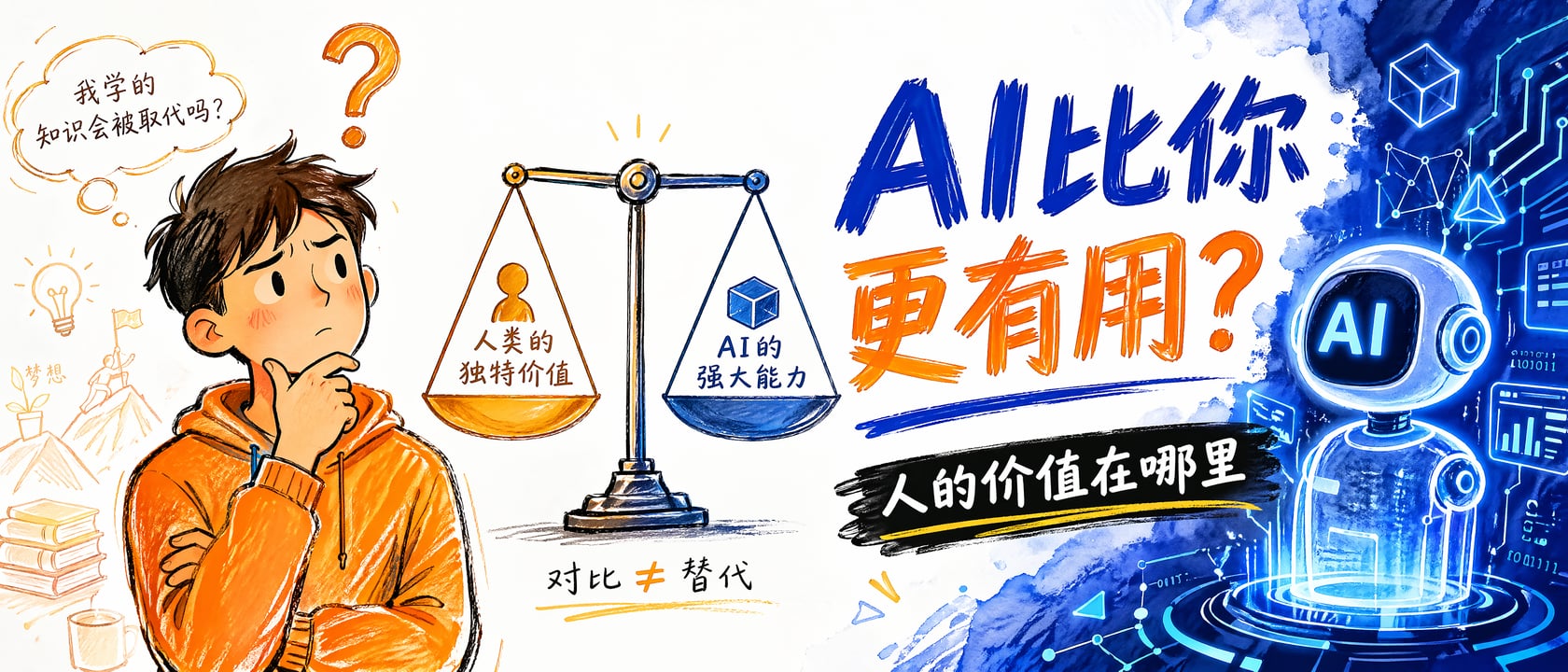
What AI truly threatens is not just whether it will take a specific job. It is that it can shake the value system many people use to confirm who they are.
For a long time, we have been used to defining ourselves by what we can do:
- I can code.
- I can write.
- I can design.
- I can analyze problems.
- I can do something faster, more accurately, and more professionally than others.
But if AI becomes faster, steadier, and cheaper than you at more and more things, the question becomes sharp:
If you are no longer more useful than the machine, what still makes you feel valuable?
This is not a technical question. It is an existential one.
1. The first thing to collapse is the idea that ability equals value
For many people, anxiety about AI looks like anxiety about income. Underneath, it is really anxiety about identity.
Modern society has long tied a person’s value to their labor capacity. What skills you have, how much output you can create, how much salary you can earn, how much responsibility you can hold in an organization, together these form a person’s social position.
So when AI starts taking over writing, coding, design, analysis, customer support, operations, and legal assistance, what it shakes is not just jobs.
It shakes a deeper sentence:
“I matter because I can do these things.”
Once that sentence loosens, people become deeply uncomfortable.
- Skills you spent ten years building can now be approximated by a model in seconds.
- What once felt like a professional moat starts becoming a default capability.
- What once gave you dignity through competence begins to lose value.
The problem is not that AI makes people completely useless. The problem is that it makes many forms of usefulness no longer scarce.
That is where the deeper anxiety comes from.
2. Humans cannot keep competing with AI on efficiency
If AI is more capable than you, the worst response is to keep competing with it on usefulness.
Trying to write faster, know more, produce more densely, process information faster, or endure repetitive work longer will probably be a losing battle.
Not because humans are lazy, but because this was never our real advantage.
Machines are good at turning input into output, compressing patterns into results, and rearranging large amounts of information. As long as a task can be clearly defined, validated, and scaled through repetition, it will increasingly belong to machines.
So the human position has to move.
Not from being a low-capability person to a high-capability person, but from being a task executor to being a task definer.
The real questions become:
- What is worth doing?
- Why do it now?
- What counts as good enough?
- What costs are unacceptable?
- Who takes responsibility for the consequences?
- Does this result still hold when placed back into real life?
These are not merely questions of capability. They are questions of judgment, responsibility, and value ordering.
AI can offer you solutions, but it cannot live a life on your behalf.
3. Judgment comes from the parts of life you have truly lived
People often say that judgment will matter most in the future.
That is true, but it can also become an empty slogan.
Judgment does not mean “I am smarter than AI.” In many knowledge-dense and high-speed reasoning tasks, humans may not be smarter.
Real judgment comes from a person’s accumulated preferences, experiences, relationships, sense of cost, and boundaries of responsibility.
What you have gone through, failed at, lost, been changed by, cared about for a long time, refused to sacrifice, or chosen to carry for others, these things together build your judgment system.
That is also where AI is hard to replace:
- AI can imitate a style, but it has never truly been changed by a relationship.
- AI can generate a plan, but it does not have to bear the real-world consequences when that plan fails.
- AI can write something that sounds human, but it does not change the course of its life by saying it.
So as outcomes become easier to replicate, lived experience itself becomes more important.
Not because experience is inherently noble, but because experience shapes judgment. Without real experience, judgment easily becomes a collage of opinions. Without real cost, choice easily becomes a language game.
4. What humans have left is not output, but authorship
One of the biggest traps in the AI era is this: people may willingly downgrade themselves into AI operators.
Every day they ask AI:
- What should I do?
- How should I choose?
- Is this opportunity worth taking?
- Is this topic worth pursuing?
- Help me plan my life.
The stronger the tool becomes, the easier it is to outsource subjectivity itself.
But the better role is not operator. It is author.
An author does not have to personally complete every detail. A film director does not shoot every frame, an architect does not lay every brick, and a strong engineering lead does not write every line of code.
But an author must still take responsibility for a few things:
- Choosing the theme
- Defining the problem
- Setting the boundaries
- Making the trade-offs
- Carrying the result
- Making the work relate back to their own life
That is the most important line between humans and AI in future collaboration.
- If you only use AI to produce more things for you, you will increasingly look like part of an assembly line.
- If you use AI to amplify your sense of problems, your judgment, and your expression, you are still the author.
The difference is not whether you use AI. It is who defines the direction in the end.
5. Value has to shift from “being needed” to “what I choose”
For a long time, many people’s sense of security came from being needed.
My company needs me, my clients need me, my team needs me, the market needs me, therefore I have value.
But AI makes “being needed” unstable. Many capabilities that are needed today may become infrastructure a few years from now. Many specializations that make money today may become default model output tomorrow.
If a person’s value is built entirely on whether the outside world still needs them, they will always be dragged around by technology and the market.
So a more stable direction is to shift part of value from “being needed” to “what I choose.”
- I choose what problems to study for the long term.
- I choose what relationships to build.
- I choose how I want to live.
- I choose what I am willing to take responsibility for.
- I choose where to invest my time, attention, and life experience.
That does not mean income is unimportant, nor does it mean people can detach from reality.
It means that as labor value starts to loosen, people need to build a structure of meaning that does not fully depend on jobs, skills, and market pricing.
Otherwise, every step AI takes forward will force the same question again: Am I useless now too?
Closing
So the question, “When AI is more useful than you, what still gives life value?” cannot be answered by saying only that “humans have emotions.”
A more accurate answer is this:
Humans can no longer rely only on usefulness to prove their worth.
Usefulness belongs to the logic of tools. Humans need the logic of life.
AI will devalue many capabilities, but it also forces people to see one thing clearly: if your value comes only from output efficiency, then you were already living like a tool.
What matters more in the future is not proving that you will always be stronger than AI, but taking back a few things:
- Your questions
- Your judgment
- Your relationships
- Your experiences
- Your choices
- Your responsibilities
AI can become more and more capable, but it cannot live this life for you.
And what humans may truly have left is exactly this: not completing tasks more efficiently, but deciding more clearly what this one life should be used to complete.