
Why Think About “Structuring”
People
A few years ago, I was lucky to read The 7 Habits of Highly Effective People (search it on Douban if you are interested). It presents a crucial logic for how we live: “Begin with the end in mind.”
It tells us to be principle-centered rather than driven by events or appearances. We need stable principles that guide our lives.
Team
Team management is the same. As a leader, you need to identify the key tasks and keep the team moving in the right direction. So you also need to “begin with the end in mind”—find stable principles for an R&D team. Then output in a structured way, improving product capability and team capability around those principles and progressing continuously.
The Compass
The team’s “compass” guides work decisions.
We should follow the principle of “begin with the end in mind” to provide a stable, structured thinking framework and work framework for various choices and decisions.
That is the core meaning of the compass.
Composition
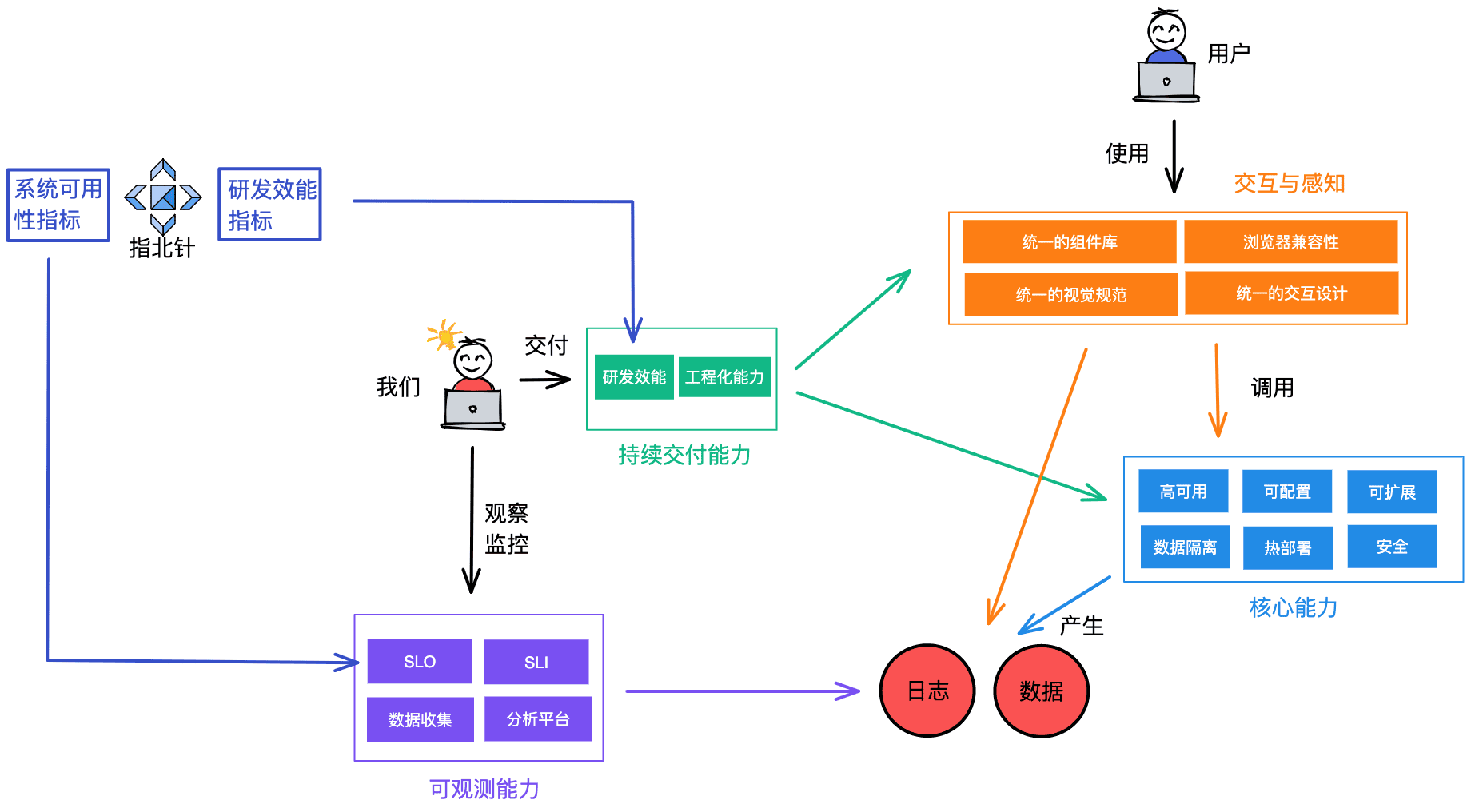
R&D Effectiveness Metrics
Goal: the ability to continuously deliver value quickly is the core objective of efficiency improvement.
| Metric Item | Sub-metric | Description |
|---|---|---|
| Delivery throughput | Number of versions delivered per unit time | The number of versions delivered in 1 month or 1 quarter (trend-focused) |
| Demand response time | Delivery cycle | Average time from demand kickoff to release |
| - | Development cycle | Average time from coding start to production release |
| Delivery quality | Bugs per story point / function point | Calculated differently by iteration type |
| - | Online issues fixed per unit time | The number of online issues fixed in 1 month or 1 quarter |
| Continuous release capability | Release frequency | Number of releases in 1 month or 1 quarter |
| - | Release time | Average time from code merge completion to production release |
System Availability Metrics
Goal: fully reflect system health, build SLI/SLO, and provide extremely high stability and availability to users.
Based on Google’s SRE theory, observe system health through SLI, SLO, and SLA.
- SLI
- SLO
- SLA
Work Logic
Our team is responsible for a SaaS product, so we abstracted a structured model of our work logic.
R&D Capability Levels
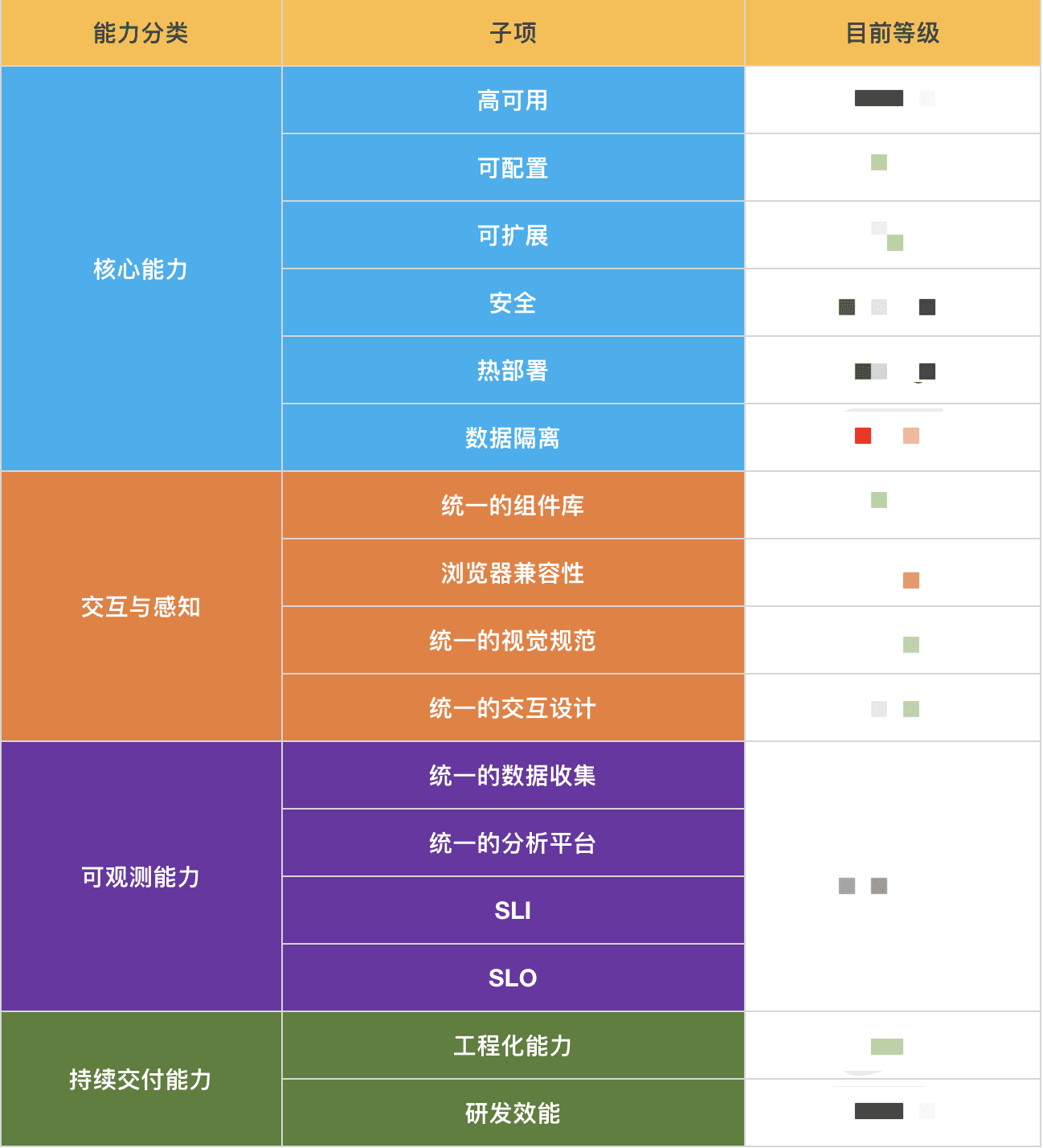
Current levels: Poor, Fair, Average, Good
Takeaways
This abstract structured work logic has been running for a while and has produced some results, such as:
- In planning, we now have a stable structure to continuously improve specific capabilities
- In goals, the team is clear about the overall plan for the next two quarters
- In decisions, we identify key tasks based on “structure” and “principles”