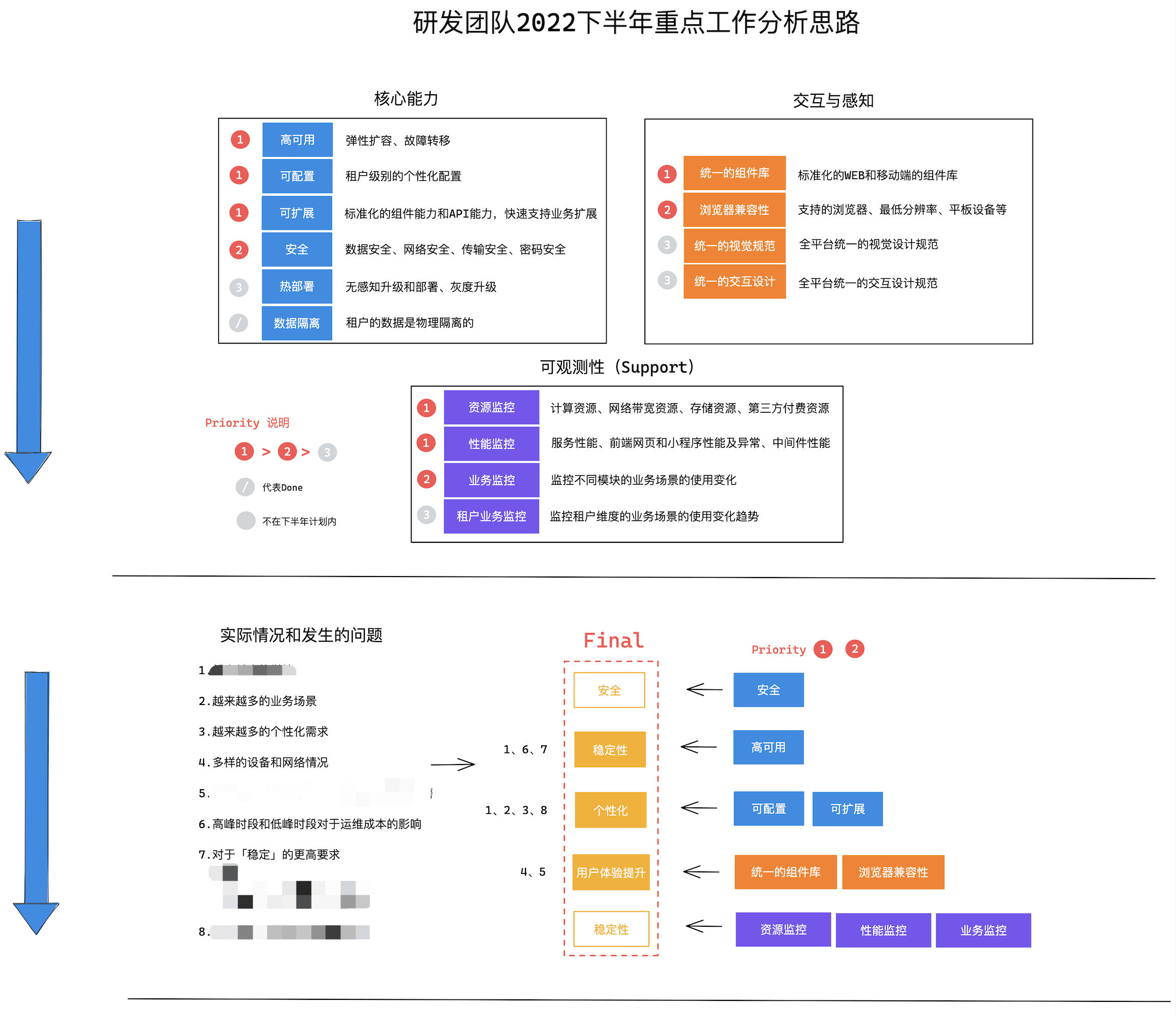
Real-World Planning
In the Q2 that just ended, we reviewed iteration results and OKRs, and then immediately had to break down Q3 OKRs. During that process, I talked with a few teammates and found that most people see planning as listing problems, setting some targets for each, and then executing. This makes target accuracy, logical consistency, and even whether something is truly a goal highly uncertain.
Methods of Planning
The way we plan reflects how we think when facing problems. Here we need to understand two basic logical analysis methods: deduction and induction.
Deduction
A method of reasoning that starts from a theory reflecting objective laws and infers unknown parts of a thing from its known parts.
Example
Aristotle’s classic syllogism is a form of deduction.
Major premise: All humans die. Minor premise: Socrates is human. Conclusion: Socrates will die.
If the premises are correct, the conclusion is correct.
Induction
A method of reasoning that, based on a series of experiences or knowledge materials, finds the basic or common laws they follow and assumes other similar things will follow those laws as well.
Example
Premise: My aunt made money with P2P, my younger aunt made money with P2P, coworker A made money with P2P. Conclusion: I will also make money with P2P.
This is a typical inductive inference: because we observe many people making money with P2P, we conclude that we can too, and we make a prediction about the future.
Which Method We Should Use
From the examples, it is clear that induction has risks: it treats the past performance of a thing as the thing’s inherent attribute, so it assumes the future trend will be the same.
With deduction, as long as the premises are correct, the conclusion is correct. Therefore, when we use deduction, we must ensure our major and minor premises are truly correct.
The method I use here is deduction.
The Value of Planning
Identify “Key Tasks”
The primary value of planning is to find the most important parts for the team or organization within complex reality, and then concentrate resources on execution.
Think from the Whole
Those who do not plan for the long term cannot plan for the short term; those who do not plan for the whole cannot plan for a part. — Chen Danran (Qing Dynasty)
Another value of planning is to think from the whole and from first principles, ensuring our plan is logical, reflects objective laws, and is based on the right premises.
As the definition of deduction says:
A method of reasoning that starts from a theory reflecting objective laws and infers unknown parts of a thing from its known parts.
Make Goals Everyone’s Goals
After planning, we should clearly explain the analytical reasoning and “why” behind the plan to the team. Only when everyone truly understands the plan can they execute the goals well.
A very important job of an R&D leader is to “identify key tasks,” find team and technical architecture problems, make systematic plans, and guide the team to solve them.
A 6-Month Planning Demo for a SaaS Product