
What Is a User Story
A user story is a short and simple description of a feature that delivers value to users or customers, and that a team can deliver within an iteration.
A user story should answer three questions:
- Who is it for? -> expected
type - What do we build? -> I want
- Why do we build it? ->
So the typical format is:
As a
, I want , so that . As a , I want to , so that .
Example: As a registered user, I want to download my photo to my profile so that other users can see what I look like.
How to Write User Stories
Hierarchy
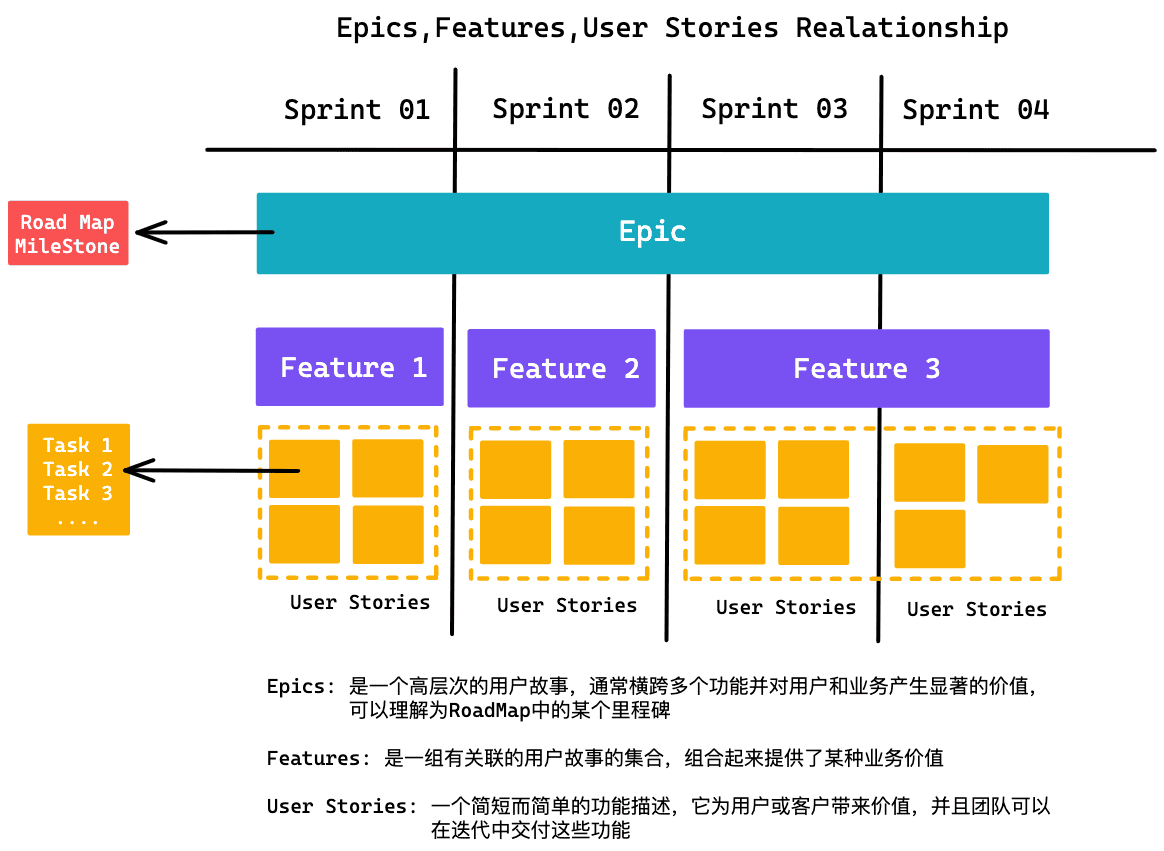
Criteria
According to the INVEST criteria, user stories should be:
-
Independent
- Not dependent on other stories (in reality this is hard, because some stories truly depend on predecessors).
-
Negotiable
- Not fixed; can be discussed.
-
Valuable
- A user story must bring clear, measurable business value. This means technical practices like refactoring, code cleanup, and architecture design are not stories. It also means a story is a vertical slice; it cannot be just a frontend or backend task.
-
Estimable
- Clear enough that the delivery team can estimate its size.
-
Small
- Should not exceed what one or two developers can deliver in a single iteration.
-
Testable
- The story must be verifiable with clear acceptance criteria.
Our User Story Template
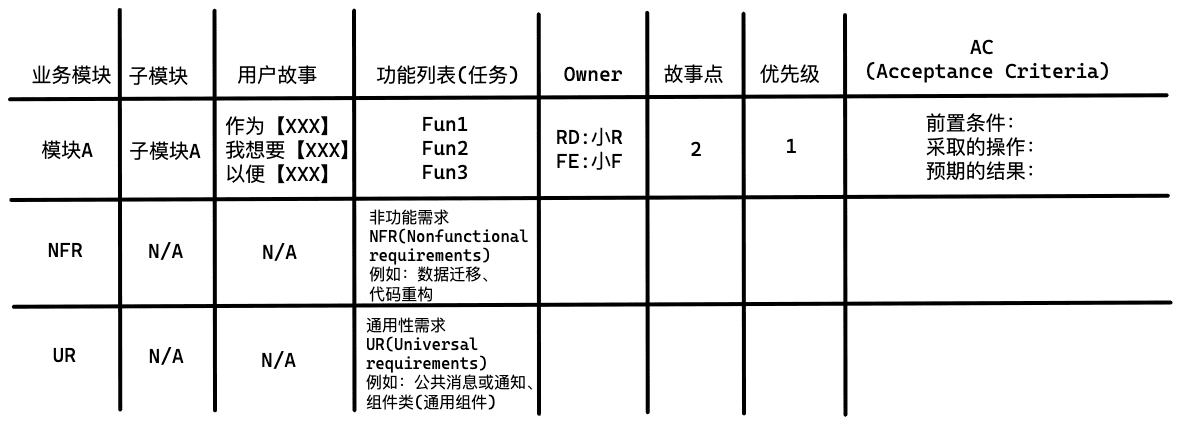
Story Writing FAQ
Q1: Can stories be split by different clients?
A1: If a story involves two clients (mobile and PC), and the story points are large and handled by different FE engineers, you can split by client.
Q1: If story points are very large, should we split the story?
A1: The standard for splitting is whether it can deliver “user-visible value.” It is not directly related to the story point size itself.
How to Estimate Story Points
What Is a Story Point
A story point is an estimate of the difficulty and workload of a story, essentially a unit of work. Story points are not a commitment and are not directly tied to actual completion time.
”Inflation” of Story Points
Code quality, developer skill, and familiarity with the business all affect delivery speed. But if different developers estimate story points by completion time, everyone will end up with a different point scale, which leads to “inflation.”

Planning Poker Estimation
Reference: Planning Poker